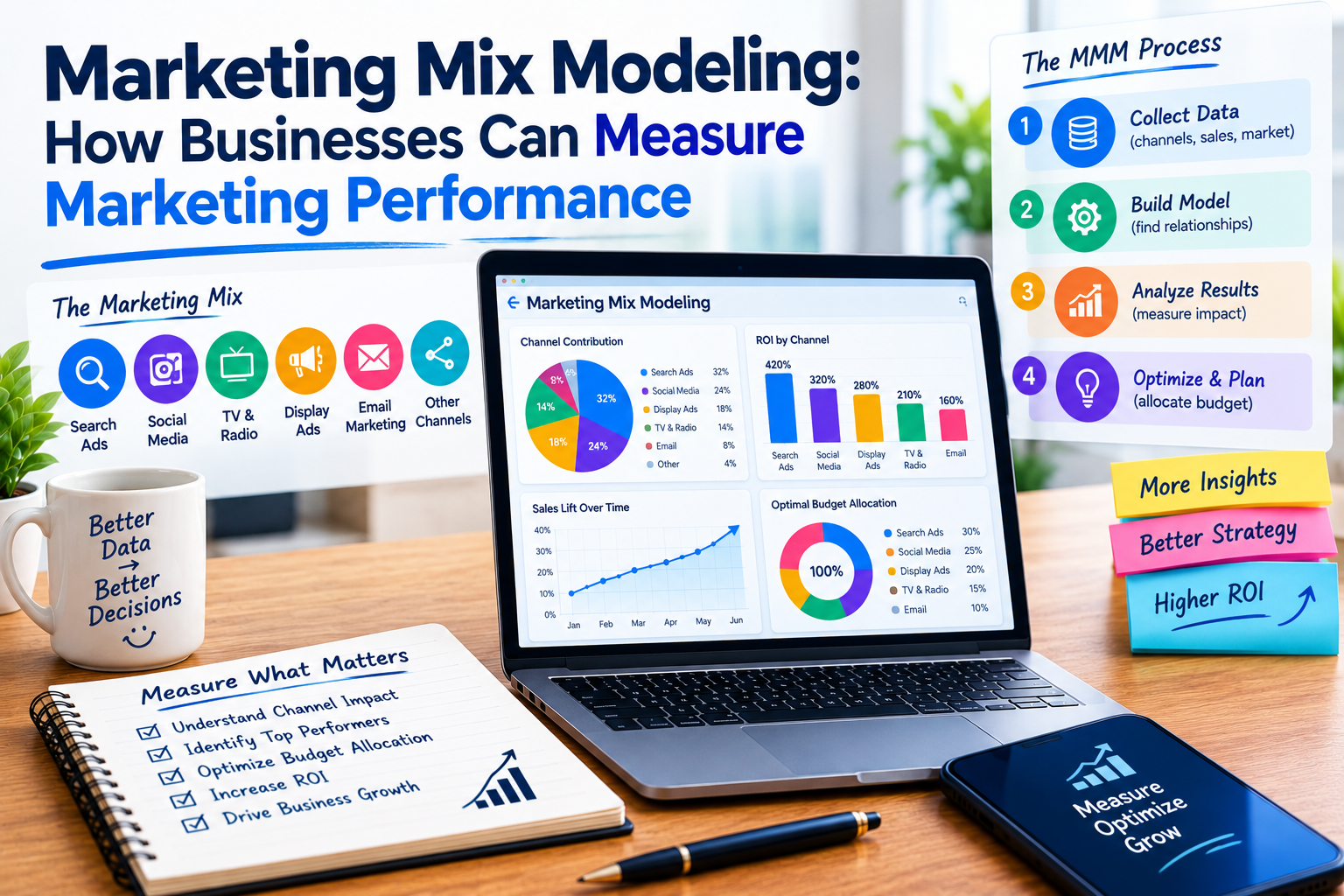
What Is Marketing Mix Modeling?
Marketing mix modeling (MMM) analyzes historical business and marketing data to estimate relationships between marketing inputs and outcomes such as sales or revenue.
Depending on the model, it may consider advertising expenditure, promotions, pricing, seasonality, distribution, and other relevant factors.
Its results are estimates and should be interpreted carefully.
Why Marketing Mix Modeling Matters
Businesses can use marketing mix modeling to:
- Evaluate marketing effectiveness
- Explore channel contributions
- Understand seasonal changes
- Compare potential budget allocations
- Support long-term planning
- Identify areas for further investigation
Collect Reliable Marketing Data
A useful model requires consistent historical information.
Depending on the business, relevant data may include:
- Marketing expenditure
- Advertising activity
- Sales or revenue
- Promotional activity
- Pricing changes
- Seasonal trends
- Distribution changes
- Relevant external factors
Data quality has a significant impact on the usefulness of the results.
Build and Validate the Model
A structured process typically includes:
- Define the business outcome.
- Gather relevant historical data.
- Check for missing or inconsistent information.
- Select an appropriate statistical approach.
- Estimate relationships between marketing inputs and outcomes.
- Validate the model using suitable methods.
- Document assumptions and uncertainty.
Complex models may require specialist analytical expertise.
Understand Marketing Mix Modeling and Attribution
Marketing attribution often examines observed customer journeys and assigns credit to different interactions.
Marketing mix modeling generally analyzes aggregated historical data over time or across markets.
Both approaches can provide useful insights, but they answer different questions.
Neither method automatically proves causation. Experiments and other validation methods can strengthen conclusions.
Use Findings to Improve Budget Decisions
Businesses can use model estimates to explore different budget scenarios.
However, avoid reallocating budgets based on a single estimate without considering uncertainty, business objectives, operational limits, and other evidence.
Small businesses may begin with simpler reporting and controlled experiments before investing in advanced modeling.
Measure Marketing Effectiveness
Depending on your business, evaluate:
- Revenue trends
- Marketing expenditure
- Cost per acquisition
- Lead generation
- Channel performance estimates
- Return on marketing investment
Choose measures that align with your business goals.
Leave a Reply