Introduction
Marketing automation has traditionally focused on predefined workflows.
For example:
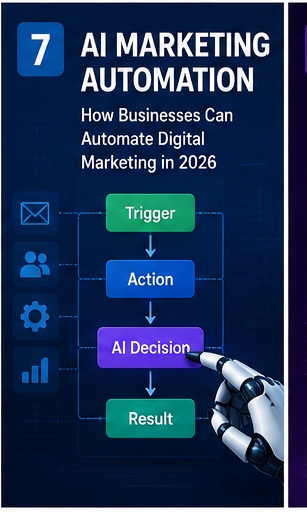
Customer submits form → Email sent → Lead added to CRM → Sales notification
AI is expanding this model by helping systems interpret information and support more complex marketing decisions.
Recent industry analysis describes a shift from AI experimentation toward deeper integration across marketing workflows.
What Can Modern Automation Support?
Depending on the technology stack, businesses can automate:
- Lead routing
- Email sequences
- Customer segmentation
- Reporting
- Campaign alerts
- Content workflows
- CRM updates
- Customer support
- Data analysis
AI-Assisted Lead Qualification
An automated system can evaluate incoming leads against predefined criteria.
For example:
Lead submits form → Data enrichment → Lead scoring → CRM assignment → Sales notification
This reduces manual work and can help sales teams prioritize higher-value opportunities.
Automation Should Not Mean Removing Humans
Automation works best when repetitive processes are handled by systems while humans manage:
- Strategy
- Relationships
- Complex decisions
- Creative direction
- Sensitive customer situations
How to Build an Automation Strategy
Start by mapping your current marketing workflow.
Identify:
- Repetitive tasks
- Manual bottlenecks
- Data sources
- Customer touchpoints
- Decision points
- Reporting requirements
Then automate the processes where technology can provide measurable value.
Conclusion
The future of marketing automation is not simply sending more automated messages.
It is creating intelligent systems that connect marketing data, customer journeys, sales processes, and analytics.
A digital marketing company can help businesses identify automation opportunities and build workflows around measurable commercial goals.
Leave a Reply