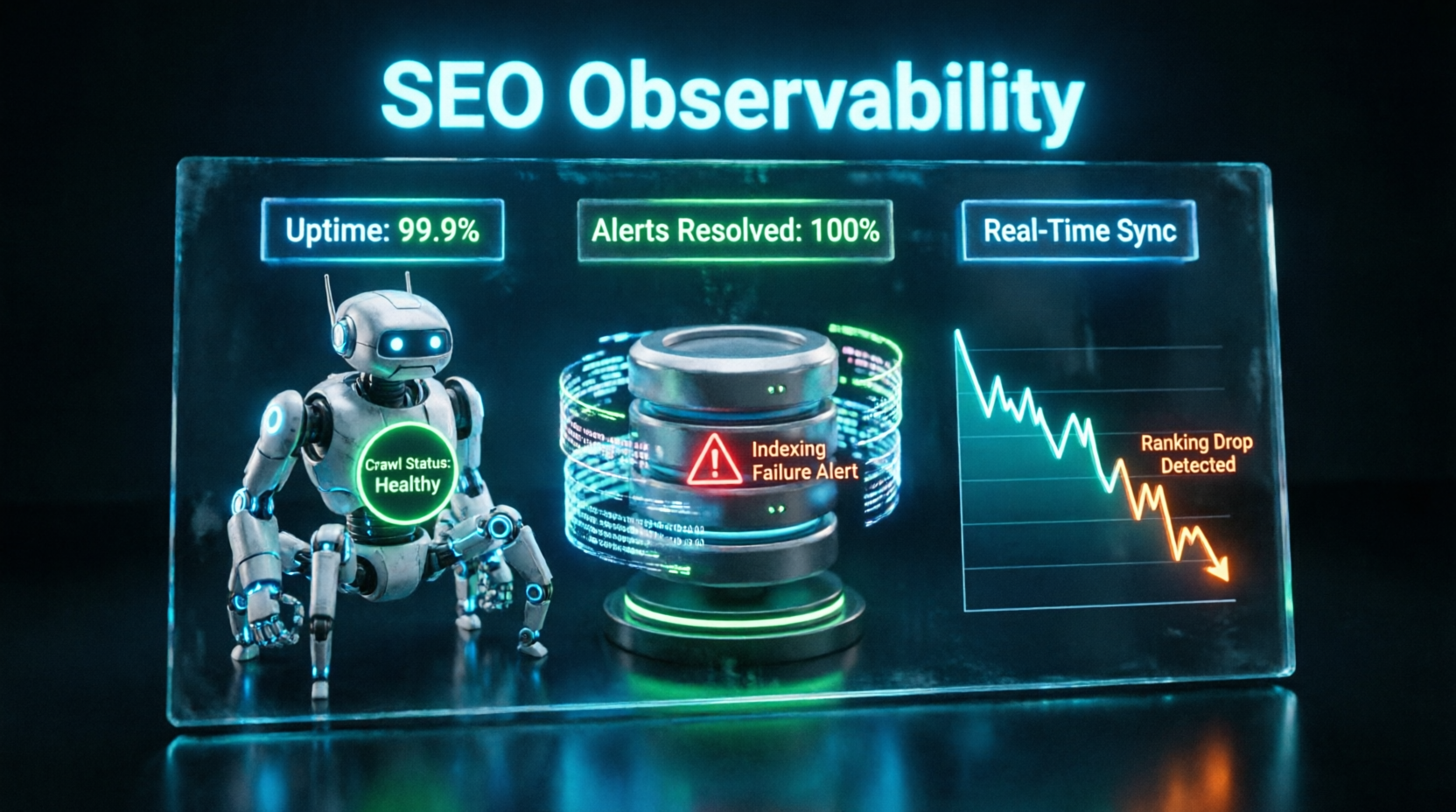
Introduction
Imagine your website suddenly returns:
500 errors on 30% of product pages.
A traditional SEO process may discover the problem after traffic falls.
An observable SEO system can detect the anomaly immediately.
What Is SEO Observability?
SEO observability means continuously monitoring the technical signals that influence search accessibility and performance.
Important monitoring layers include:
Infrastructure
- uptime
- server errors
- response time
Crawling
- bot activity
- crawl patterns
- status codes
Indexing
- indexed URLs
- excluded URLs
- canonical changes
Search Performance
- impressions
- clicks
- CTR
- visibility
Google’s Search Console reporting can help site owners monitor search performance, including dedicated reporting for generative AI visibility introduced in 2026.
Build SEO Alerts
Examples:
Alert: Organic clicks decreased 30%
Alert: 404 responses increased 400%
Alert: Canonical mismatch detected
Alert: Indexable URLs decreased
Alert: Robots.txt changed
These alerts can be routed to technical teams.
Use Baselines
A simple threshold is not always enough.
For example, traffic naturally changes by:
- weekday
- season
- holidays
- promotions
- market
A smarter monitoring system compares current performance with historical baselines.
Connect Technical and Business Data
The most valuable alert isn’t:
“500 error detected.”
It is:
“500 errors detected on 8,500 product URLs representing 34% of organic revenue.”
This changes prioritization immediately.
SEO Disaster Prevention
Observability can also monitor deployment changes.
Before and after a website release, compare:
- indexability
- canonicals
- robots directives
- internal links
- structured data
- response codes
This creates an SEO safety layer around development.
Final Takeaway
SEO should not operate like a monthly inspection.
For large businesses, SEO observability can transform technical SEO from reactive troubleshooting into continuous operational monitoring.
Leave a Reply