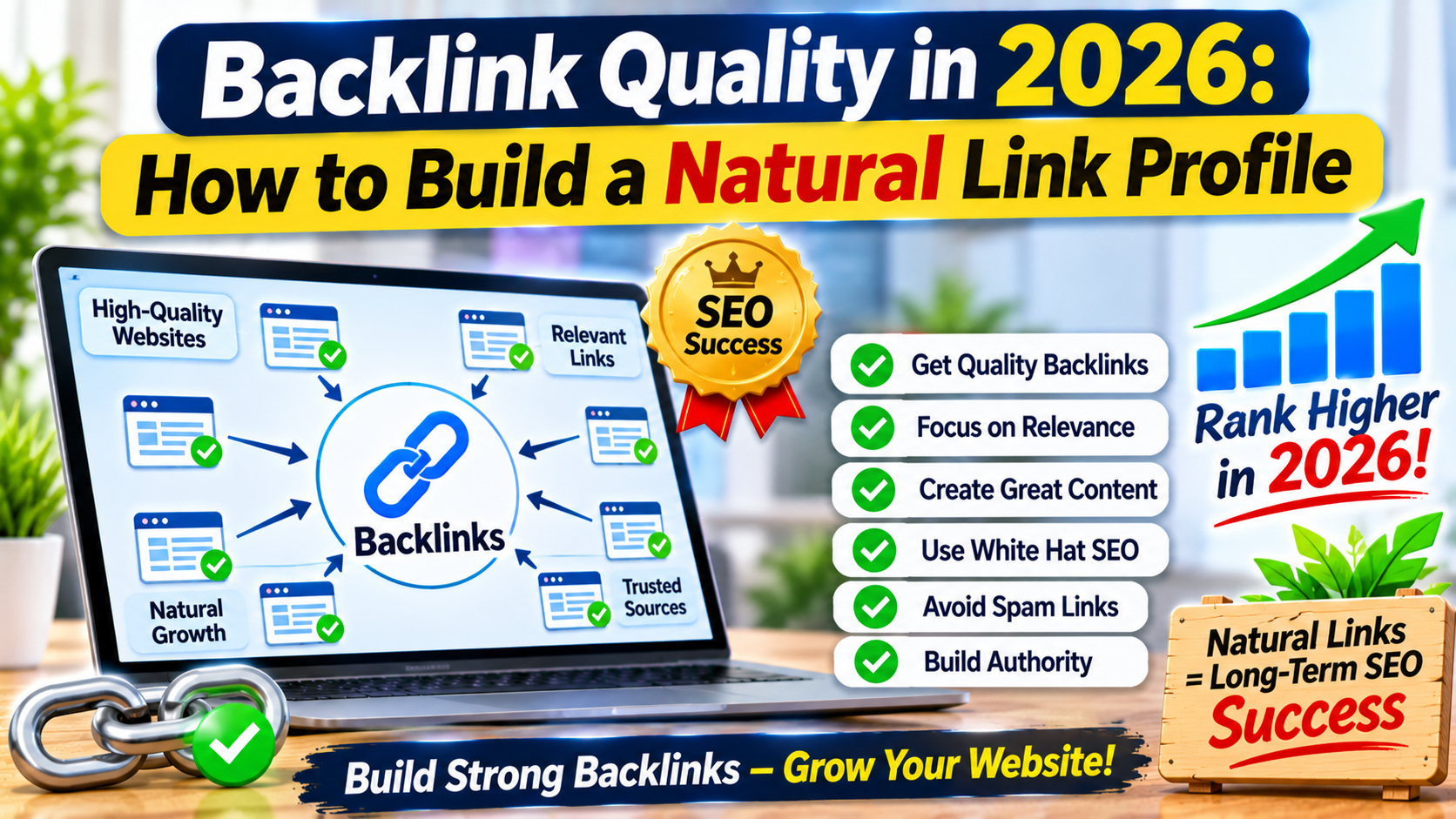
What Is Backlink Quality?
Backlink quality refers to how relevant, trustworthy, and useful a link is within its context.
A valuable backlink generally comes from a page that naturally references your content because it provides useful information.
Important considerations include:
- Relevance of the linking website
- Quality of the linking page
- Context surrounding the link
- Natural placement
- Editorial purpose
- Whether the link is intended to manipulate rankings
A website’s authority score from an SEO tool is an estimate, not a direct Google ranking metric.
1. Focus on Relevant Websites
Relevance is an important consideration when building backlinks.
For example, a digital marketing company may benefit from relevant links from:
- Marketing blogs
- Business publications
- Technology websites
- SEO resources
- Industry-related educational websites
Avoid pursuing links simply because a website has a high third-party authority score.
2. Publish Link-Worthy Content
Useful content gives other websites a reason to reference your pages.
Create resources such as:
- Original research
- Industry reports
- Detailed guides
- Case studies
- Helpful statistics
- Practical tutorials
- Free tools and templates
Content should provide genuine value rather than exist only to attract links.
3. Use Guest Posting Carefully
Guest posting can help businesses reach new audiences and contribute useful knowledge to relevant publications.
A responsible guest posting strategy should include:
- Selecting relevant websites
- Reviewing editorial standards
- Publishing original content
- Providing useful information
- Disclosing commercial relationships where appropriate
- Using links according to search engine guidelines
Avoid large-scale guest posting campaigns created primarily to manipulate rankings.
4. Analyze Your Existing Backlink Profile
Review your website’s backlinks using Google Search Console and reputable SEO tools.
Look for:
- Relevant referring websites
- Links to important pages
- Broken backlinks
- Unusual link patterns
- Sudden changes in backlink activity
Do not assume that every unfamiliar or low-metric backlink is harmful.
5. Use Natural Anchor Text
Anchor text is the clickable text used in a hyperlink.
A natural backlink profile may contain different types of anchor text, including:
- Brand names
- Website URLs
- Descriptive phrases
- Natural contextual wording
- Relevant keywords where appropriate
Avoid repeatedly forcing exact-match keywords into backlinks.
6. Avoid Manipulative Link-Building Practices
Search engines may treat certain link-building practices as link spam.
Avoid:
- Buying links intended to manipulate rankings
- Automated link creation
- Private blog networks used for ranking manipulation
- Excessive link exchanges
- Irrelevant directory submissions
- Large-scale low-quality guest posting
Focus on genuine editorial references and useful relationships.
7. Monitor Backlink Performance
Track backlink growth and evaluate whether links contribute to meaningful business outcomes.
Monitor:
- Referring domains
- Relevant backlinks
- Referral traffic
- Leads from referral sources
- Important linked pages
- Changes in link profile
Remember that backlinks alone do not guarantee higher rankings.
Leave a Reply