Blog

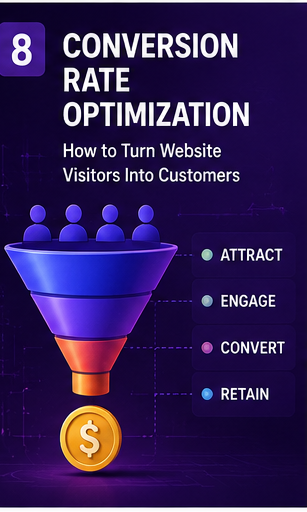
  • Conversion Rate Optimization in 2026: Turning Website Traffic Into Customers

    Conversion Rate Optimization in 2026: Turning Website Traffic Into Customers

    Introduction

    Many businesses focus heavily on generating website traffic.

    But traffic is only one part of the customer journey.

    If 10,000 people visit a website but very few take action, the marketing strategy has a conversion problem.

    What Is Conversion Rate Optimization?

    Conversion Rate Optimization (CRO) is the systematic process of improving a website so that more visitors complete a desired action.

    Conversions can include:

    • Form submissions
    • Phone calls
    • Purchases
    • Consultation requests
    • Newsletter registrations
    • Demo bookings

    Technical CRO Factors

    Page speed

    Slow pages can create friction.

    Mobile usability

    Forms and buttons must work properly on smaller screens.

    Website architecture

    Visitors should quickly understand where to go next.

    Forms

    Long or confusing forms can reduce submissions.

    Tracking

    Businesses need reliable analytics to understand which changes produce results.

    Content and CRO

    Good content should answer:

    • What does the company offer?
    • Who is it for?
    • Why should customers choose it?
    • What proof exists?
    • What should the visitor do next?

    A/B Testing

    A/B testing can compare different versions of:

    • Headlines
    • CTAs
    • Landing pages
    • Forms
    • Offers
    • Page layouts

    Testing should be based on a clear hypothesis rather than random changes.

    CRO and SEO Together

    SEO brings qualified visitors.

    CRO helps convert those visitors.

    The strongest digital marketing strategies therefore connect acquisition and conversion rather than treating them as separate activities.

    Conclusion

    The goal of digital marketing is not simply more traffic.

    The goal is more valuable business outcomes from the right traffic.

    A professional agency can analyze your website funnel and identify opportunities to improve both traffic quality and conversion performance.

  • Digital Marketing Automation: How AI Agents Are Changing Marketing Workflows

    Digital Marketing Automation: How AI Agents Are Changing Marketing Workflows

    Introduction

    Marketing automation has traditionally focused on predefined workflows.

    For example:

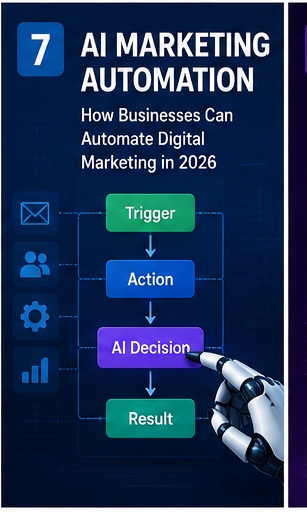
    Customer submits form → Email sent → Lead added to CRM → Sales notification

    AI is expanding this model by helping systems interpret information and support more complex marketing decisions.

    Recent industry analysis describes a shift from AI experimentation toward deeper integration across marketing workflows.

    What Can Modern Automation Support?

    Depending on the technology stack, businesses can automate:

    • Lead routing
    • Email sequences
    • Customer segmentation
    • Reporting
    • Campaign alerts
    • Content workflows
    • CRM updates
    • Customer support
    • Data analysis

    AI-Assisted Lead Qualification

    An automated system can evaluate incoming leads against predefined criteria.

    For example:

    Lead submits form → Data enrichment → Lead scoring → CRM assignment → Sales notification

    This reduces manual work and can help sales teams prioritize higher-value opportunities.

    Automation Should Not Mean Removing Humans

    Automation works best when repetitive processes are handled by systems while humans manage:

    • Strategy
    • Relationships
    • Complex decisions
    • Creative direction
    • Sensitive customer situations

    How to Build an Automation Strategy

    Start by mapping your current marketing workflow.

    Identify:

    1. Repetitive tasks
    2. Manual bottlenecks
    3. Data sources
    4. Customer touchpoints
    5. Decision points
    6. Reporting requirements

    Then automate the processes where technology can provide measurable value.

    Conclusion

    The future of marketing automation is not simply sending more automated messages.

    It is creating intelligent systems that connect marketing data, customer journeys, sales processes, and analytics.

    A digital marketing company can help businesses identify automation opportunities and build workflows around measurable commercial goals.

  • First-Party Data Strategy for Digital Marketing in 2026

    First-Party Data Strategy for Digital Marketing in 2026

    Introduction

    Digital marketing is increasingly moving toward data that businesses collect directly from their customers.

    This is known as first-party data.

    Examples include:

    • Email subscribers
    • Customer purchases
    • Website interactions
    • CRM records
    • Form submissions
    • Loyalty-program activity
    • Customer preferences

    Why First-Party Data Matters

    Direct customer data can help businesses understand audiences without depending entirely on external targeting systems.

    It can support:

    • Personalization
    • Customer segmentation
    • Email marketing
    • Retargeting strategies
    • Customer retention
    • Predictive analysis

    Industry analysis in 2026 continues to identify first-party data as an important response to changing privacy and tracking conditions.

    How to Build a First-Party Data Strategy

    Create useful conversion points

    Offer valuable resources, newsletters, consultations, or tools that encourage voluntary sign-ups.

    Connect data systems

    CRM, website analytics, email platforms, and sales systems should work together where appropriate.

    Segment customers

    Not every customer has the same needs.

    Segment audiences according to meaningful business criteria.

    Respect consent

    Data collection should be transparent and aligned with applicable privacy requirements.

    First-Party Data and AI

    AI can help marketers identify patterns within properly collected and governed data.

    For example, businesses can analyze:

    • Customer behavior
    • Purchase history
    • Lead quality
    • Campaign performance
    • Engagement patterns

    Conclusion

    The future of data-driven marketing is not simply about collecting more information.

    It is about collecting useful information responsibly and turning it into better customer experiences.

    A digital marketing company can help businesses build an integrated strategy connecting data, CRM, advertising, analytics, and conversion optimization.

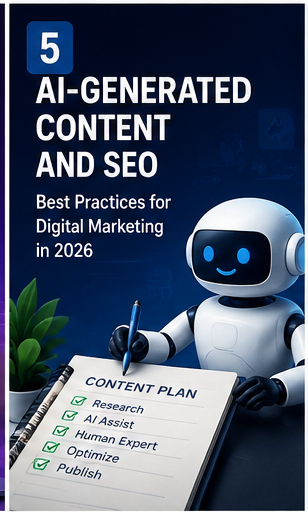
  • AI Content and SEO: How to Use Generative AI Without Sacrificing Quality

    AI Content and SEO: How to Use Generative AI Without Sacrificing Quality

    Introduction

    Generative AI has become an important part of modern marketing workflows.

    Businesses use AI to assist with:

    • Research
    • Content outlines
    • Data analysis
    • Content variations
    • Marketing ideas
    • Customer segmentation
    • Campaign development

    However, AI should support expertise rather than replace it.

    Google’s guidance emphasizes the importance of helpful content and evaluates content based on its value to users rather than simply whether AI was involved in its production.

    The Problem With Mass AI Content

    Publishing hundreds of automatically generated pages without adding meaningful value can create:

    • Repetitive content
    • Weak differentiation
    • Incorrect information
    • Poor user experience
    • Brand trust issues

    A Better AI Content Workflow

    Step 1: Human research

    Identify the audience, search intent, competitors, and business expertise.

    Step 2: AI-assisted planning

    Use AI to organize ideas and identify potential questions.

    Step 3: Expert writing

    Add original knowledge, examples, opinions, data, and practical experience.

    Step 4: Fact checking

    Verify statistics, claims, technical information, and references.

    Step 5: SEO optimization

    Improve headings, internal links, metadata, structure, and search intent alignment.

    Step 6: Human editing

    Remove generic language and make the content genuinely useful.

    Why Human Expertise Matters

    AI can generate fluent text, but businesses differentiate themselves through experience.

    A digital marketing agency can add value by publishing:

    • Campaign case studies
    • Real performance insights
    • Client lessons
    • Original research
    • Industry analysis
    • Practical frameworks

    Conclusion

    The winning model is not AI versus humans.

    It is AI + human expertise.

    AI can improve speed and efficiency while marketers provide judgment, creativity, accuracy, and strategic thinking.

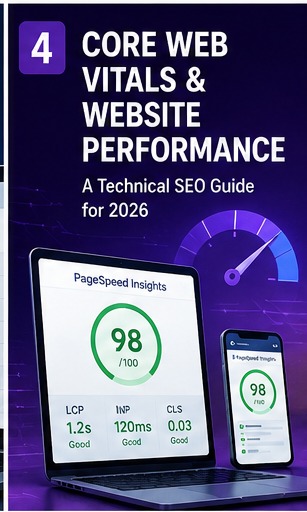
  • Core Web Performance and SEO: Why Website Speed Still Matters in 2026

    Core Web Performance and SEO: Why Website Speed Still Matters in 2026

    Introduction

    Website performance is no longer simply a developer concern. It is a marketing concern.

    A slow website can create friction between a potential customer and a conversion.

    For digital marketing companies, performance optimization should therefore be connected with SEO, UX, and conversion-rate optimization.

    What Makes a Website Perform Well?

    Performance depends on several technical factors, including:

    • Server response time
    • Image optimization
    • JavaScript execution
    • CSS delivery
    • Caching
    • Content delivery networks
    • Font loading
    • Third-party scripts

    Why Mobile Performance Matters

    Many customers discover businesses through mobile devices.

    A website that works well on desktop but performs poorly on mobile can lose potential customers before they even read the offer.

    Common Performance Problems

    Oversized images

    Uncompressed images can dramatically increase page weight.

    Excessive JavaScript

    Too much JavaScript can delay page interactivity.

    Unnecessary plugins

    CMS websites can accumulate plugins that add unnecessary scripts.

    Poor hosting

    Server infrastructure affects response time and reliability.

    Too many third-party scripts

    Analytics, advertising, chat widgets, and tracking tools can add processing overhead.

    A Practical Optimization Process

    Start by measuring the website.

    Then:

    1. Identify the slowest pages.
    2. Analyze major resources.
    3. Compress and resize images.
    4. Reduce unnecessary JavaScript.
    5. Improve caching.
    6. Review third-party scripts.
    7. Optimize server response.
    8. Retest after implementation.

    Performance and Conversion Rate

    Speed optimization should not be evaluated only through technical scores.

    Track business outcomes such as:

    • Engagement
    • Lead submissions
    • Calls
    • Purchases
    • Bounce behavior
    • Conversion rate

    The goal is a faster website that also generates better business results.

    Conclusion

    Website performance is an important component of modern digital marketing.

    SEO professionals, developers, and conversion specialists should work together rather than treating speed as an isolated technical task.

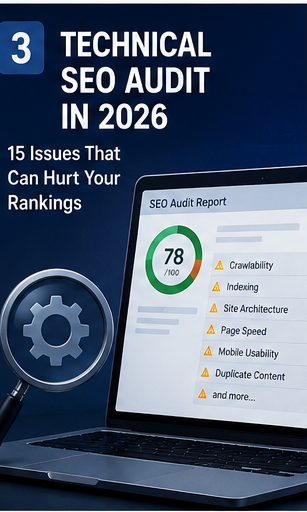
  • Technical SEO in 2026: 12 Website Issues That Can Destroy Organic Visibility

    Technical SEO in 2026: 12 Website Issues That Can Destroy Organic Visibility

    Introduction

    Technical SEO is the infrastructure behind organic search visibility.

    Even excellent content may perform poorly if search engines cannot efficiently crawl, render, understand, or index a website.

    Google explains that its Search systems discover, crawl, index, and serve web content, but following best practices does not guarantee indexing or rankings.

    12 Technical SEO Problems

    1. Poor website architecture

    Important pages should be accessible through a logical structure.

    2. Indexing problems

    Pages that should appear in search must not accidentally be blocked from indexing.

    3. Broken internal links

    Broken links waste crawl opportunities and create poor user experiences.

    4. Duplicate content

    Multiple URLs containing substantially similar content can complicate search engine understanding.

    5. Slow page performance

    Users expect websites to load quickly, particularly on mobile devices.

    6. Poor mobile experience

    A website should function correctly across different screen sizes.

    7. Incorrect canonical tags

    Canonicalization helps communicate the preferred version of similar URLs.

    8. Missing or incorrect redirects

    Website migrations and URL changes require carefully planned redirects.

    9. Poor XML sitemaps

    Sitemaps should accurately represent important canonical URLs.

    10. Weak internal linking

    Important pages should receive appropriate internal links.

    11. JavaScript rendering problems

    Important content should be accessible to search engines.

    12. Security problems

    HTTPS and secure website infrastructure are essential for modern websites.

    How to Conduct a Technical SEO Audit

    A professional audit typically examines:

    • Crawlability
    • Indexability
    • Site architecture
    • Metadata
    • Canonicals
    • Redirects
    • Sitemaps
    • Structured data
    • Performance
    • Mobile usability
    • Internal linking
    • Security

    Why Technical SEO Should Be Continuous

    Technical SEO is not a one-time task.

    New pages, plugins, redesigns, migrations, tracking systems, and CMS updates can introduce problems.

    Regular technical audits help businesses identify issues before they become significant organic-search problems.

    Conclusion

    Technical SEO provides the foundation for sustainable organic visibility.

    If your website receives little organic traffic despite having good content, a technical audit may reveal the missing piece.

    A professional digital marketing company can identify technical barriers and create a prioritized SEO implementation roadmap.

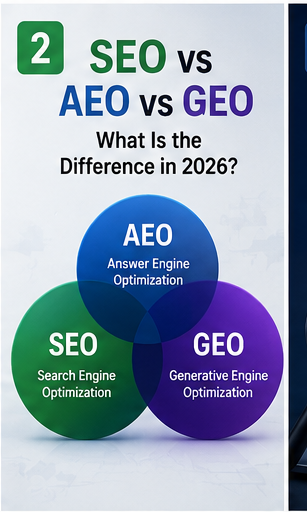
  • AEO vs SEO vs GEO: The Complete Guide to Search Optimization in 2026

    AEO vs SEO vs GEO: The Complete Guide to Search Optimization in 2026

    Introduction

    Search behavior is changing rapidly. People still use traditional search engines, but they are also asking questions through AI-powered platforms and conversational search interfaces.

    This has created new terminology around search optimization, including SEO, AEO, and GEO.

    What Is SEO?

    Search Engine Optimization focuses on improving a website’s visibility in traditional search results.

    Core SEO activities include:

    • Keyword research
    • On-page optimization
    • Technical SEO
    • Link building
    • Content creation
    • Website performance optimization

    What Is AEO?

    Answer Engine Optimization (AEO) focuses on making content easier for answer engines to understand and use when responding to questions.

    AEO emphasizes:

    • Direct answers
    • Frequently asked questions
    • Conversational queries
    • Structured information
    • Clear content organization

    What Is GEO?

    Generative Engine Optimization (GEO) focuses on improving the likelihood that a brand or website is represented in AI-generated answers.

    The growing importance of AI search has led marketers to think beyond traditional rankings and consider how brands are represented inside generated responses. Google now provides official guidance around optimizing websites for generative AI search features.

    How They Work Together

    A strong strategy does not necessarily choose one approach.

    Instead:

    SEO → Visibility in search results

    AEO → Visibility for direct questions

    GEO → Visibility within generative AI experiences

    The technical foundation overlaps considerably.

    Five Practical Strategies

    Build authoritative content

    Create comprehensive resources around your core services.

    Use clear question-based headings

    Structure content around the problems customers actually ask.

    Strengthen internal linking

    Connect related pages so search engines can understand relationships between topics.

    Maintain consistent business information

    Your company name, services, contact information, and brand descriptions should be accurate across important digital properties.

    Measure more than rankings

    Monitor organic traffic, leads, conversions, brand visibility, and relevant AI-search mentions where measurable.

    Why Businesses Need a Unified Strategy

    Treating SEO, AEO, and GEO as completely separate disciplines can create unnecessary duplication.

    A technically strong website with authoritative content can support multiple discovery channels simultaneously.

    Conclusion

    Search optimization is evolving from ranking webpages toward making brands discoverable and understandable across multiple search experiences.

    Businesses that combine technical SEO, useful content, and clear brand information can build a stronger foundation for the search ecosystem of 2026 and beyond.

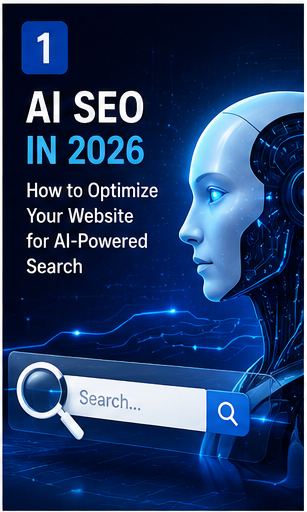
  • AI-Powered SEO in 2026: How Businesses Can Optimize for Google AI Search

    AI-Powered SEO in 2026: How Businesses Can Optimize for Google AI Search

    Introduction

    Search engine optimization is entering a new phase in 2026. Users are increasingly asking longer, conversational questions and receiving AI-generated answers directly within search engines. Google has introduced guidance specifically for website owners looking to improve visibility in generative AI features such as AI Overviews and AI Mode.

    For businesses, this means SEO is no longer only about ranking a webpage for a keyword. Your website must also provide information that search systems can understand, trust, retrieve, and potentially cite.

    What Is AI-Powered SEO?

    AI-powered SEO involves optimizing your website so that search engines and AI systems can understand the subject, expertise, context, and reliability of your content.

    Traditional SEO focuses heavily on:

    • Keywords
    • Rankings
    • Backlinks
    • Technical optimization
    • Search intent

    Modern SEO increasingly combines these fundamentals with:

    • Natural-language content
    • Structured information
    • Strong topical authority
    • First-hand expertise
    • Entity understanding
    • Clear answers to user questions

    Why Traditional SEO Still Matters

    AI search does not eliminate technical SEO.

    Google continues to recommend fundamental practices such as crawlable pages, useful content, appropriate page structure, and strong technical foundations.

    Businesses should therefore avoid treating AI SEO as a replacement for SEO. Instead, it should be viewed as an additional layer.

    How to Prepare Your Website

    1. Create genuinely useful content

    Write content that solves specific customer problems instead of producing articles simply to target keywords.

    2. Answer questions directly

    Use clear headings and concise answers before expanding into technical explanations.

    3. Demonstrate expertise

    Include original examples, case studies, statistics, processes, and practical recommendations.

    4. Improve technical SEO

    Make sure important pages can be crawled, indexed, rendered, and accessed efficiently.

    5. Build topical authority

    Instead of publishing random articles, create interconnected content around your primary services.

    The Role of a Digital Marketing Agency

    AI search optimization requires SEO, content strategy, technical SEO, analytics, and conversion optimization to work together.

    A professional digital marketing company can audit your existing website, identify content gaps, optimize technical elements, and build a long-term search strategy.

    Conclusion

    The future of SEO is not about abandoning Google rankings. It is about becoming visible wherever customers search—including traditional results and AI-powered search experiences.

    Businesses that build technically sound, useful, trustworthy websites now will be better positioned for the evolving search landscape.