Introduction
Traditional SEO often focused on matching a target keyword with a page. Modern search is considerably more sophisticated. Search systems can interpret concepts, relationships, entities and user intent rather than depending exclusively on exact keyword matches.
Google’s current guidance for generative AI search emphasizes that AI features are built on Google’s existing Search ranking and quality systems. It also highlights query fan-out, where a complex query can lead to multiple related searches to find information from different sources.
This creates a new technical opportunity: semantic retrieval engineering.
What Is Semantic Retrieval?
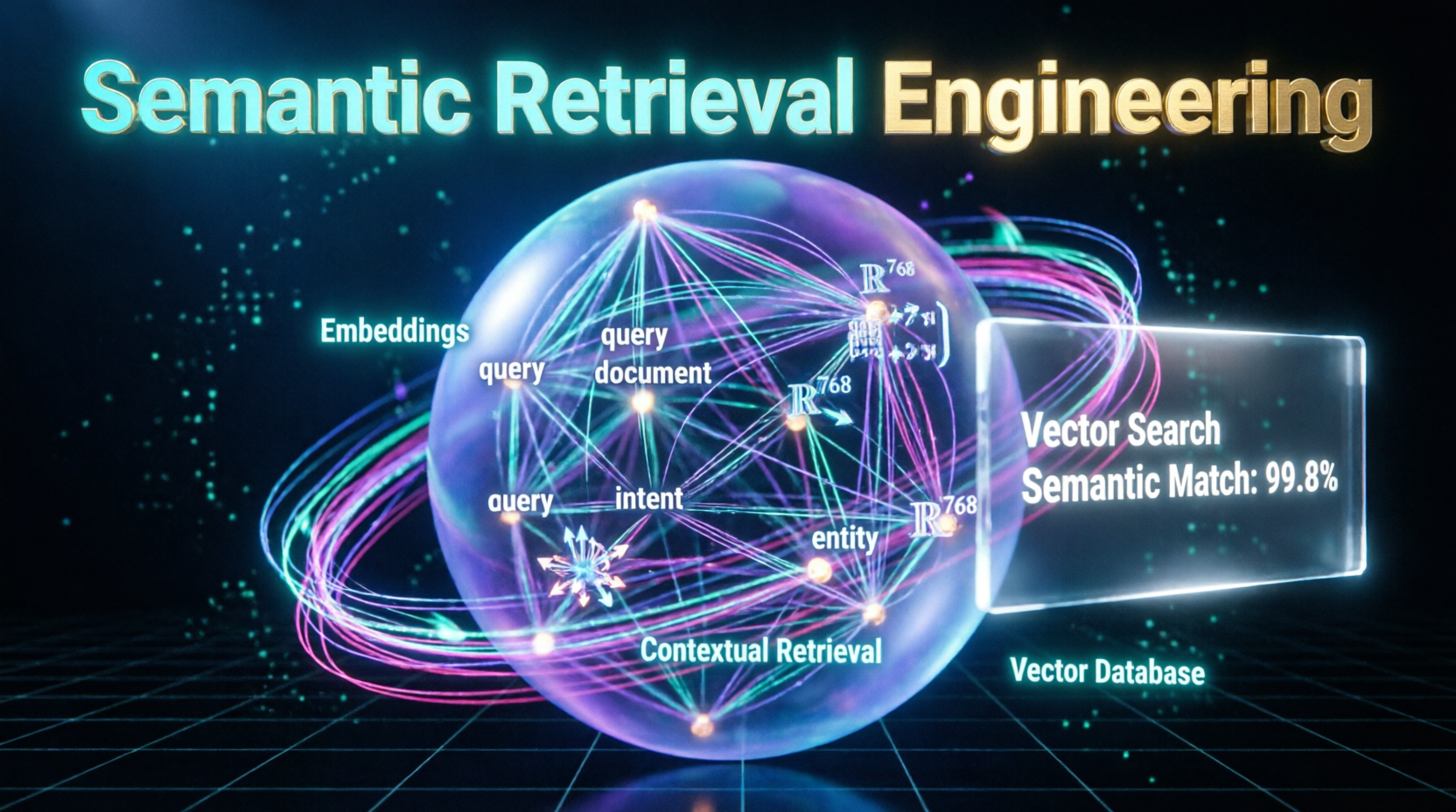
Semantic retrieval attempts to find information based on meaning rather than exact wording.
For example, a user searching:
“How can a small company get customers online?”
may be looking for information about:
- SEO
- paid advertising
- conversion optimization
- social media
- local search
- content marketing
A technically strong website should make these relationships clear.
Build Topic-Level Content Architecture
Instead of creating dozens of pages targeting tiny keyword variations, build a structured information architecture.
For example:
Digital Marketing
→ SEO
→ Technical SEO
→ Local SEO
→ Content Marketing
→ PPC
→ Conversion Optimization
Each section should contain authoritative pages connected through meaningful internal links.
Optimize for Concepts, Not Keyword Density
Advanced SEO should focus on:
- entities
- relationships
- terminology
- supporting concepts
- user questions
- original evidence
- contextual internal links
Avoid artificially inserting keywords into every paragraph.
Google explicitly states that there is no requirement to rewrite content specifically for AI systems or create artificially short “chunks” for AI.
Build Retrieval-Friendly Pages
A technically strong page should have:
- A clear primary topic
- Descriptive headings
- Strong contextual relationships
- Supporting evidence
- Relevant internal links
- Structured information where appropriate
- Crawlable and indexable HTML
Structured data can help search engines understand page information, although it is not a special requirement for appearing in generative AI features.
Final Takeaway
The future of SEO is not about repeating keywords. It is about making your website understandable as an information system.
A professional digital marketing company can help businesses build semantic content architectures that improve discoverability across traditional search and emerging AI search experiences.
Leave a Reply