Blog

  • Technical SEO in 2026: 12 Website Issues That Can Destroy Organic Visibility

    Technical SEO in 2026: 12 Website Issues That Can Destroy Organic Visibility

    Introduction

    Technical SEO is the infrastructure behind organic search visibility.

    Even excellent content may perform poorly if search engines cannot efficiently crawl, render, understand, or index a website.

    Google explains that its Search systems discover, crawl, index, and serve web content, but following best practices does not guarantee indexing or rankings.

    12 Technical SEO Problems

    1. Poor website architecture

    Important pages should be accessible through a logical structure.

    2. Indexing problems

    Pages that should appear in search must not accidentally be blocked from indexing.

    3. Broken internal links

    Broken links waste crawl opportunities and create poor user experiences.

    4. Duplicate content

    Multiple URLs containing substantially similar content can complicate search engine understanding.

    5. Slow page performance

    Users expect websites to load quickly, particularly on mobile devices.

    6. Poor mobile experience

    A website should function correctly across different screen sizes.

    7. Incorrect canonical tags

    Canonicalization helps communicate the preferred version of similar URLs.

    8. Missing or incorrect redirects

    Website migrations and URL changes require carefully planned redirects.

    9. Poor XML sitemaps

    Sitemaps should accurately represent important canonical URLs.

    10. Weak internal linking

    Important pages should receive appropriate internal links.

    11. JavaScript rendering problems

    Important content should be accessible to search engines.

    12. Security problems

    HTTPS and secure website infrastructure are essential for modern websites.

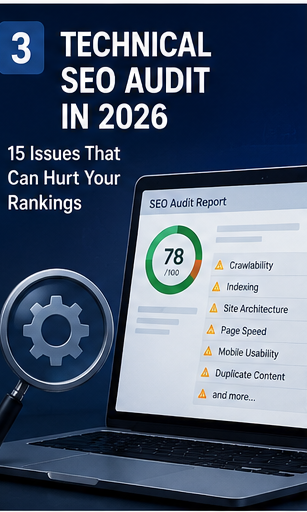
    How to Conduct a Technical SEO Audit

    A professional audit typically examines:

    • Crawlability
    • Indexability
    • Site architecture
    • Metadata
    • Canonicals
    • Redirects
    • Sitemaps
    • Structured data
    • Performance
    • Mobile usability
    • Internal linking
    • Security

    Why Technical SEO Should Be Continuous

    Technical SEO is not a one-time task.

    New pages, plugins, redesigns, migrations, tracking systems, and CMS updates can introduce problems.

    Regular technical audits help businesses identify issues before they become significant organic-search problems.

    Conclusion

    Technical SEO provides the foundation for sustainable organic visibility.

    If your website receives little organic traffic despite having good content, a technical audit may reveal the missing piece.

    A professional digital marketing company can identify technical barriers and create a prioritized SEO implementation roadmap.
  • AEO vs SEO vs GEO: The Complete Guide to Search Optimization in 2026

    AEO vs SEO vs GEO: The Complete Guide to Search Optimization in 2026

    Introduction

    Search behavior is changing rapidly. People still use traditional search engines, but they are also asking questions through AI-powered platforms and conversational search interfaces.

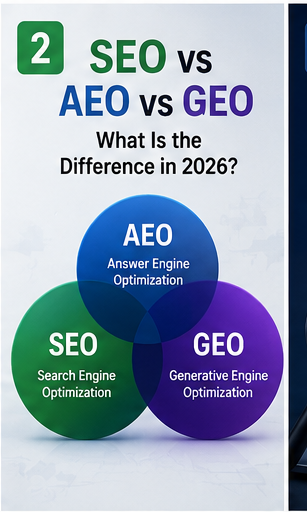
    This has created new terminology around search optimization, including SEO, AEO, and GEO.

    What Is SEO?

    Search Engine Optimization focuses on improving a website’s visibility in traditional search results.

    Core SEO activities include:

    • Keyword research
    • On-page optimization
    • Technical SEO
    • Link building
    • Content creation
    • Website performance optimization

    What Is AEO?

    Answer Engine Optimization (AEO) focuses on making content easier for answer engines to understand and use when responding to questions.

    AEO emphasizes:

    • Direct answers
    • Frequently asked questions
    • Conversational queries
    • Structured information
    • Clear content organization

    What Is GEO?

    Generative Engine Optimization (GEO) focuses on improving the likelihood that a brand or website is represented in AI-generated answers.

    The growing importance of AI search has led marketers to think beyond traditional rankings and consider how brands are represented inside generated responses. Google now provides official guidance around optimizing websites for generative AI search features.

    How They Work Together

    A strong strategy does not necessarily choose one approach.

    Instead:

    SEO → Visibility in search results

    AEO → Visibility for direct questions

    GEO → Visibility within generative AI experiences

    The technical foundation overlaps considerably.

    Five Practical Strategies

    Build authoritative content

    Create comprehensive resources around your core services.

    Use clear question-based headings

    Structure content around the problems customers actually ask.

    Strengthen internal linking

    Connect related pages so search engines can understand relationships between topics.

    Maintain consistent business information

    Your company name, services, contact information, and brand descriptions should be accurate across important digital properties.

    Measure more than rankings

    Monitor organic traffic, leads, conversions, brand visibility, and relevant AI-search mentions where measurable.

    Why Businesses Need a Unified Strategy

    Treating SEO, AEO, and GEO as completely separate disciplines can create unnecessary duplication.

    A technically strong website with authoritative content can support multiple discovery channels simultaneously.

    Conclusion

    Search optimization is evolving from ranking webpages toward making brands discoverable and understandable across multiple search experiences.

    Businesses that combine technical SEO, useful content, and clear brand information can build a stronger foundation for the search ecosystem of 2026 and beyond.

  • AI-Powered SEO in 2026: How Businesses Can Optimize for Google AI Search

    AI-Powered SEO in 2026: How Businesses Can Optimize for Google AI Search

    Introduction

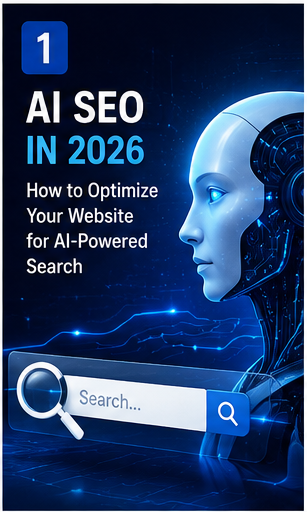
    Search engine optimization is entering a new phase in 2026. Users are increasingly asking longer, conversational questions and receiving AI-generated answers directly within search engines. Google has introduced guidance specifically for website owners looking to improve visibility in generative AI features such as AI Overviews and AI Mode.

    For businesses, this means SEO is no longer only about ranking a webpage for a keyword. Your website must also provide information that search systems can understand, trust, retrieve, and potentially cite.

    What Is AI-Powered SEO?

    AI-powered SEO involves optimizing your website so that search engines and AI systems can understand the subject, expertise, context, and reliability of your content.

    Traditional SEO focuses heavily on:

    • Keywords
    • Rankings
    • Backlinks
    • Technical optimization
    • Search intent

    Modern SEO increasingly combines these fundamentals with:

    • Natural-language content
    • Structured information
    • Strong topical authority
    • First-hand expertise
    • Entity understanding
    • Clear answers to user questions

    Why Traditional SEO Still Matters

    AI search does not eliminate technical SEO.

    Google continues to recommend fundamental practices such as crawlable pages, useful content, appropriate page structure, and strong technical foundations.

    Businesses should therefore avoid treating AI SEO as a replacement for SEO. Instead, it should be viewed as an additional layer.

    How to Prepare Your Website

    1. Create genuinely useful content

    Write content that solves specific customer problems instead of producing articles simply to target keywords.

    2. Answer questions directly

    Use clear headings and concise answers before expanding into technical explanations.

    3. Demonstrate expertise

    Include original examples, case studies, statistics, processes, and practical recommendations.

    4. Improve technical SEO

    Make sure important pages can be crawled, indexed, rendered, and accessed efficiently.

    5. Build topical authority

    Instead of publishing random articles, create interconnected content around your primary services.

    The Role of a Digital Marketing Agency

    AI search optimization requires SEO, content strategy, technical SEO, analytics, and conversion optimization to work together.

    A professional digital marketing company can audit your existing website, identify content gaps, optimize technical elements, and build a long-term search strategy.

    Conclusion

    The future of SEO is not about abandoning Google rankings. It is about becoming visible wherever customers search—including traditional results and AI-powered search experiences.

    Businesses that build technically sound, useful, trustworthy websites now will be better positioned for the evolving search landscape.