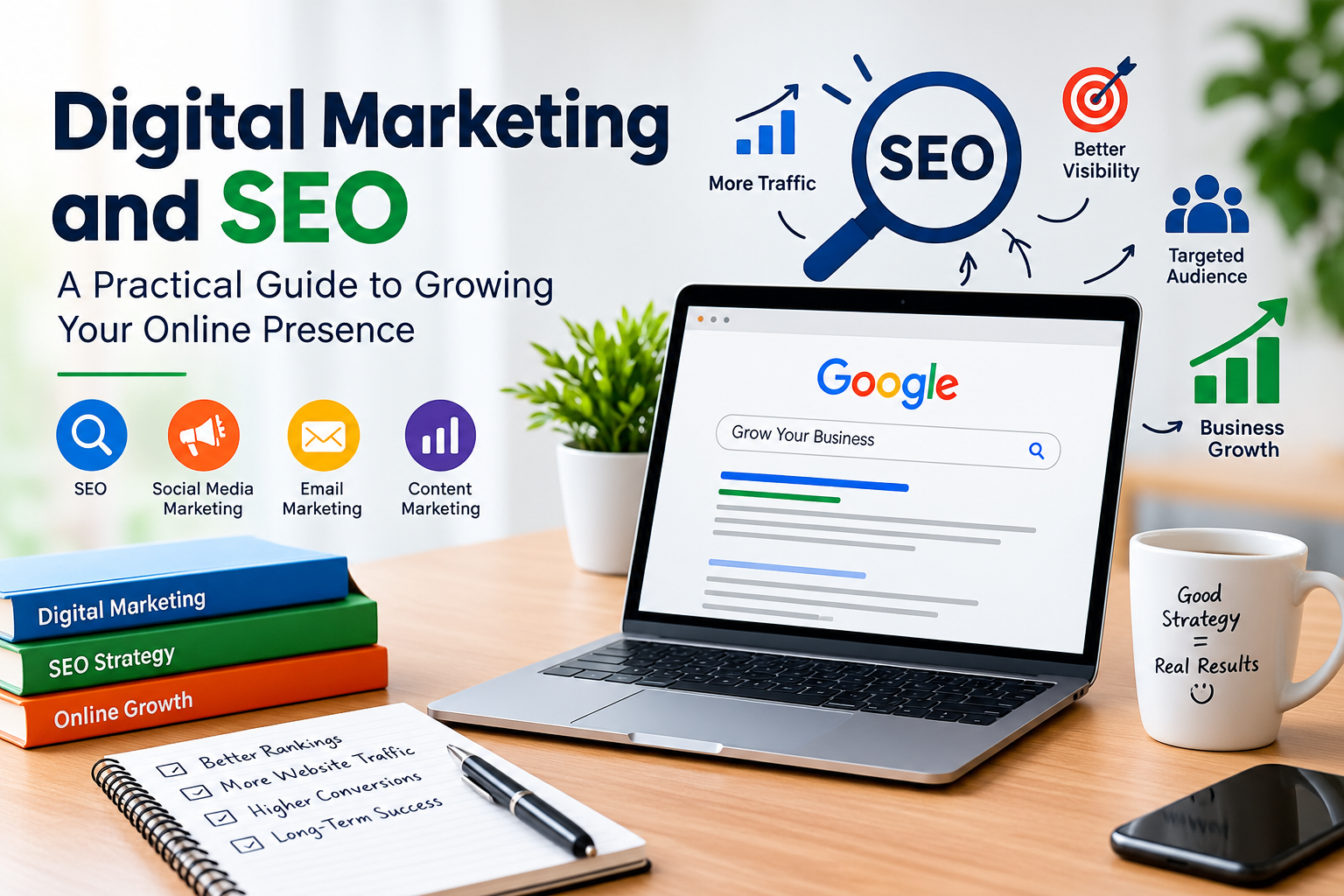
n today’s digital world, having an online presence is important for businesses, brands, and individuals looking to reach a wider audience. However, simply creating a website is not enough. Businesses need a strategy that helps people discover their content, understand their products or services, and eventually become customers.
This is where digital marketing and SEO play an important role. Digital marketing covers a broad range of online promotional activities, while search engine optimization focuses on improving a website’s visibility in search engine results.
Understanding how these two areas work together can help businesses build a stronger and more sustainable online presence.
What Is Digital Marketing?
Digital marketing refers to marketing activities that use digital channels and technologies to reach an audience. These channels can include search engines, websites, social media platforms, email, online advertising, and content marketing.
A digital marketing strategy may include several different methods, such as:
- Search engine optimization
- Content marketing
- Social media marketing
- Email marketing
- Search advertising
- Display advertising
- Influencer marketing
- Video marketing
The right combination depends on the business, target audience, goals, and available resources.
What Is SEO?
Search engine optimization, commonly known as SEO, is the process of improving a website and its content so that search engines can better understand and index it.
A strong SEO strategy can help relevant pages appear when people search for information, products, or services related to a business.
SEO generally involves several areas, including:
On-Page SEO
On-page SEO focuses on elements that exist directly on a website. These can include page titles, headings, content structure, internal links, images, URLs, and the overall usefulness of the content.
Well-organized pages make it easier for both users and search engines to understand the subject of a page.
Technical SEO
Technical SEO focuses on the technical aspects of a website that can affect crawling, indexing, performance, and usability.
Important areas can include website speed, mobile usability, site architecture, structured data, crawlability, and indexation.
A technically healthy website gives search engines a clearer path to discover and understand its content.
Off-Page SEO
Off-page SEO involves activities outside a website that can contribute to its online visibility and reputation.
Link building is one commonly discussed part of off-page SEO. When other relevant websites reference useful content, those links can help users discover the site and may contribute to how search engines understand the site’s reputation.
However, link building should focus on quality and relevance rather than simply collecting a large number of links.
Why Content Matters for SEO
Content is one of the central elements of a successful SEO strategy.
Search engines aim to provide users with useful results. For that reason, creating content primarily for search engines rather than people can lead to a poor user experience.
Effective SEO content should:
- Address a clear search intent
- Provide useful and accurate information
- Be easy to read
- Use descriptive headings
- Naturally include relevant terminology
- Answer common questions
- Provide original value
- Be updated when information changes
Instead of repeatedly inserting the same keyword, content should cover the topic naturally and comprehensively.
Keyword Research and Search Intent
Keyword research helps marketers understand what people are searching for online.
For example, someone searching for “SEO basics” may be looking for educational information, while someone searching for “SEO agency” may be looking for a service provider.
Understanding this difference is known as search intent.
Common types of search intent include:
- Informational intent
- Navigational intent
- Commercial investigation
- Transactional intent
Creating content that matches the intent behind a search query can make a website more useful to its target audience.
How Digital Marketing and SEO Work Together
SEO can bring organic search visibility, while other digital marketing channels can help distribute content and reach potential customers.
For example, a business might publish an informative SEO article on its website, promote it through social media, include it in an email newsletter, and use paid advertising to reach a specific audience.
Each channel can serve a different purpose.
SEO can support long-term organic visibility, while paid campaigns may provide faster exposure. Social media can help build engagement, while email marketing can help businesses communicate directly with existing audiences.
A coordinated strategy can therefore be more effective than treating every marketing channel as a completely separate activity.
Building an Effective SEO Strategy
Businesses starting with SEO can benefit from following a structured process.
1. Define Your Audience
Understand who you are trying to reach. Consider their interests, problems, questions, and purchasing behavior.
2. Research Relevant Keywords
Identify phrases that are relevant to your business and useful to your target audience. Focus on relevance and search intent rather than choosing keywords solely because they have high search volume.
3. Create Useful Content
Develop original content that genuinely answers the questions and needs of your audience.
4. Improve Website Structure
Make your website easy to navigate. Use logical categories, descriptive URLs, internal links, and clear page structures.
5. Work on Technical SEO
Regularly review website performance, mobile usability, indexing, and other technical factors.
6. Build Relevant Online References
Promote useful content and develop relationships with relevant websites and publications. Avoid manipulative link-building practices and focus on genuine relevance.
7. Measure Results
Use appropriate analytics and search performance tools to understand how your website is performing and where improvements may be needed.
Common Digital Marketing and SEO Mistakes
Some businesses make the mistake of expecting immediate results from SEO. Organic search growth can take time and depends on factors such as competition, website quality, content, authority, and consistency.
Other common mistakes include:
- Creating low-quality content in large quantities
- Overusing keywords
- Buying poor-quality backlinks
- Ignoring mobile users
- Publishing content without understanding search intent
- Neglecting technical SEO
- Focusing only on rankings instead of users
- Failing to update outdated information
A sustainable strategy generally focuses on providing value while following search engine guidelines.
The Importance of Consistency
Digital marketing is not a one-time activity. Search trends, customer expectations, competitors, and online platforms continue to change.
Publishing useful content consistently, monitoring performance, improving existing pages, and adapting marketing campaigns can help businesses maintain their online presence over time.
Consistency does not necessarily mean publishing every day. A realistic schedule that allows a business to maintain quality is often more practical.
Final Thoughts
Digital marketing and SEO work together to help businesses build visibility, reach relevant audiences, and create stronger online experiences.
SEO can help people discover useful content through search engines, while digital marketing provides additional channels for promoting that content and communicating with potential customers.
The most sustainable approach is to focus on the audience first: understand what people need, create genuinely useful content, maintain a technically sound website, and promote valuable resources through relevant channels.
With a clear strategy and consistent effort, businesses can build a stronger digital presence while creating content that provides lasting value to their audience.